The National Pest Management Association (NPMA) has created the Termite Hub, a central location for everything you "wood" ever want to know about termites - from FAQ's and prevention tips to current news. So I thought I'd share some of this information with you.
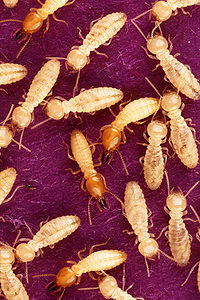
Termites silently chew through walls, floors, ceilings and even wallpaper with scissor-like jaws. They feast on wood 24 hours a day, 7 days a week. And with upwards of 2 million members in a single colony, they can cause serious and costly damage to a home in a matter of weeks or months.
While this may sound like the beginning of a horror movie, it is a reality that many homeowners face when they find that their home has been infested with termites. In fact, termites cause more than $5 billion in property damage every year. Worse still, is the fact that damage caused by termites is not usually covered by homeowners' insurance policies, making prevention and education key in protecting your home from termites.
If you're concerned that you have termites in your home or place of business, give Dave a call at 1-800-400-6009.
Dave's Pest Control
A Central Massachusetts Pest Control Company
www.davespestcontrol.net
Reference: www.pestworld.org
April 30, 2011
April 28, 2011
"Bee" Vigilant
There are several species of yellowjackets. These flying insects typically have a yellow and black head/face and patterned abdomen. Many say, the pattern resembles stripes. Signature to species, the abdomen pattern can help an entomologist or pest professional identify specific types of yellowjackets.
Yellowjackets nest in the ground or in cavernous areas such as eaves and attics. They feed on sweets and proteins and commonly invade outdoor activities.
These stinging bees can be found anyplace humans can be found. Check near recycling bins or other areas where sugars are common but keep in mind these pests also feed on protein.
Yellowjackets pose significant health threats to humans as they may sting repeatedly and can cause allergic reactions. Stinging insects send over 500,000 people to the emergency room each year.
Remain vigilant and call a Dave if you suspect yellowjacket activity. Control requires specialized equipment and safety precautions. Do not leave sweet drinks or meats in accessible areas. For example, clean up and remove food and trash after picnics and outdoor events.
If you're concerned that you have yellowjackets around your home or place of business, give Dave a call at 1-800-400-6009.
Dave's Pest Control
A Central Massachusetts Pest Control Company
www.davespestcontrol.net
Reference: www.pestworld.org
Yellowjackets nest in the ground or in cavernous areas such as eaves and attics. They feed on sweets and proteins and commonly invade outdoor activities.
These stinging bees can be found anyplace humans can be found. Check near recycling bins or other areas where sugars are common but keep in mind these pests also feed on protein.
Yellowjackets pose significant health threats to humans as they may sting repeatedly and can cause allergic reactions. Stinging insects send over 500,000 people to the emergency room each year.
Remain vigilant and call a Dave if you suspect yellowjacket activity. Control requires specialized equipment and safety precautions. Do not leave sweet drinks or meats in accessible areas. For example, clean up and remove food and trash after picnics and outdoor events.
If you're concerned that you have yellowjackets around your home or place of business, give Dave a call at 1-800-400-6009.
Dave's Pest Control
A Central Massachusetts Pest Control Company
www.davespestcontrol.net
Reference: www.pestworld.org
April 26, 2011
Lyme Disease
The blacklegged tick is named for its dark legs, which are a contrast to its pale body. Blacklegged ticks are sometimes called deer ticks. These ticks like to feed on the blood of white-tailed deer, which is why they are sometimes called deer ticks; and they can spread Lyme Disease.
Blacklegged ticks prefer to hide in grass and shrubs. So, when you are in an area where ticks are common, wear long sleeved shirts and pants, preferably light colored so ticks will be easy to detect. Tuck pants into socks. Use a tick repellent. When you return indoors, inspect clothing and skin thoroughly for ticks, including head. Wash clothes immediately.
If you're concerned that you have deer ticks around your home or place of business, give Dave a call at 1-800-400-6009.
Dave's Pest Control
A Central Massachusetts Pest Control Company
www.davespestcontrol.net
Reference: www.pestworld.org
Blacklegged ticks prefer to hide in grass and shrubs. So, when you are in an area where ticks are common, wear long sleeved shirts and pants, preferably light colored so ticks will be easy to detect. Tuck pants into socks. Use a tick repellent. When you return indoors, inspect clothing and skin thoroughly for ticks, including head. Wash clothes immediately.
If you're concerned that you have deer ticks around your home or place of business, give Dave a call at 1-800-400-6009.
Dave's Pest Control
A Central Massachusetts Pest Control Company
www.davespestcontrol.net
Reference: www.pestworld.org
April 24, 2011
Projects for Science Fairs
Dave's Pest Control has teamed up with Pest World For Kids*, a web site that explores pest ecology as the intersection between human-created habitats and animal needs for food and shelter. Designed for students and teachers in the elementary and middle school grade, the web site offers information resources, interactive learning games, science fair kits, and lesson plans that support national standards developed by the National Science Teacher Association and the National Council of Teachers of English.
Looking for a project to do for your science fair? Try these downloadable science fair kits. They provide everything you need to get started thinking like a scientist, from forming a question to communicating results of your experiment.
Here is one kit your kids might enjoy doing -- Which Came First: The Fly or The Egg?
Fruit flies are not only pests but they are also incredibly helpful in scientific research. For this project, you will start by observing the fruit fly life cycle. Then you will follow the scientific method to test how temperature affects fly development during their life cycle.
* Pestworld for Kids.org is part of the National Pest Management Association
Dave's Pest Control
A Central Massachusetts Pest Control Company
www.davespestcontrol.net
Looking for a project to do for your science fair? Try these downloadable science fair kits. They provide everything you need to get started thinking like a scientist, from forming a question to communicating results of your experiment.
Here is one kit your kids might enjoy doing -- Which Came First: The Fly or The Egg?
Fruit flies are not only pests but they are also incredibly helpful in scientific research. For this project, you will start by observing the fruit fly life cycle. Then you will follow the scientific method to test how temperature affects fly development during their life cycle.
- Age Range: Fourth Grade to Eighth Grade
- Time Required: 2 weeks to 1 month or longer (if you choose).
- Cost: Minimal - most materials are readily found in many home kitchens.
* Pestworld for Kids.org is part of the National Pest Management Association
Dave's Pest Control
A Central Massachusetts Pest Control Company
www.davespestcontrol.net
April 22, 2011
Termite FAQs - Part 3
![]() |
| Wood destroyed by termites |
2. What is the most effective type of termite treatment? The National Pest Management Association and the entire industry are committed to providing highly effective treatment options for all pest issues. The most effective type of treatment depends upon the severity of the infestation, the species of termite, and the location and construction of the home or building. A trained and licensed pest control professional can assess each infestation separately and recommend a rigorous treatment plan that will effectively control the termite population.
3. How difficult are termites to treat? Termites are nearly impossible for homeowners to treat on their own. On the other hand, Dave's Pest Control has the training, expertise and technology to eliminate termite infestations.
If you're concerned that you have termites in your home or place of business, give Dave a call at 1-800-400-6009.
Dave's Pest Control
A Central Massachusetts Pest Control Company
www.davespestcontrol.net
Reference: www.pestworld.org
April 20, 2011
Her Majesty, The Termite Queen
Meet the Queen, compliments of National Geographic.
Fact: The Queen termite can produce 30,000 eggs per day ....that's 10,950,000 eggs per year!!!
So, if you're concerned that you have termites in your home or place of business, give Dave a call at 1-800-400-6009.
Dave's Pest Control
A Central Massachusetts Pest Control Company
www.davespestcontrol.net
Fact: The Queen termite can produce 30,000 eggs per day ....that's 10,950,000 eggs per year!!!
So, if you're concerned that you have termites in your home or place of business, give Dave a call at 1-800-400-6009.
Dave's Pest Control
A Central Massachusetts Pest Control Company
www.davespestcontrol.net
April 18, 2011
Termite FAQS - Part 2
![]() |
| Formosan subterranean termite |
2. What can a homeowner do to prevent termites? The most important thing is to remove the conducive conditions termites need to survive. Termites love moisture; avoid moisture accumulation around the foundation of your home.
Prevent termites by diverting water away with properly functioning downspouts, gutters and splash blocks. Reduce humidity in crawl spaces with proper ventilation. Prevent shrubs, vines and other vegetation from growing over and covering vents. Be sure to remove old form boards, grade stakes, etc., left in place after the building was constructed.
Remove old tree stumps and roots around and beneath the building. Most importantly, eliminate any wood contact with the soil. An 18-inch gap between the soil and wood portions of the building is ideal. It doesn't hurt to routinely inspect the foundation of your home for signs of termite damage.
If you're concerned that you have termites in your home or place of business, give Dave a call at 1-800-400-6009.
Dave's Pest Control
A Central Massachusetts Pest Control Company
www.davespestcontrol.net
Reference: www.pestworld.org
Subscribe to:
Posts (Atom)


